


Senate Deals Setback to Clean Energy Projects With Tax and Spending Package
[ad_1]

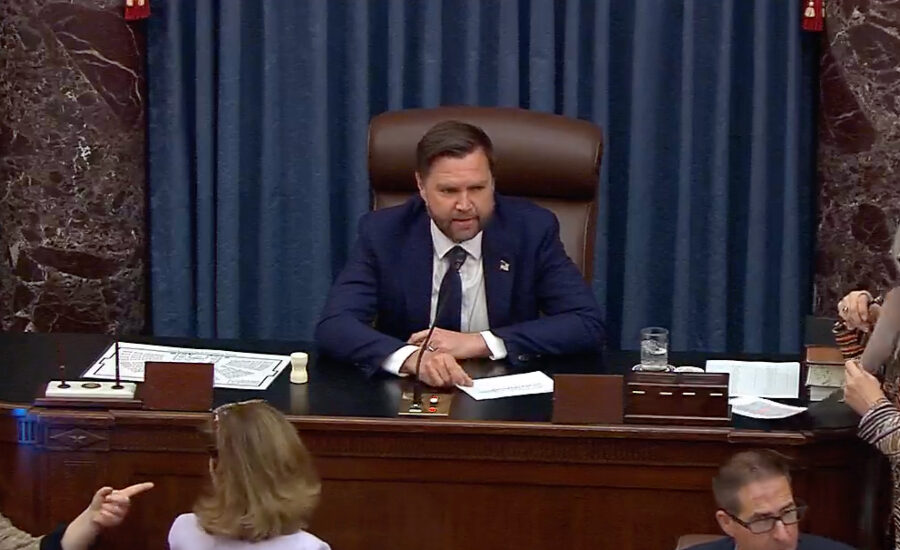
With a tie-breaking vote by Vice President J.D. Vance July 1, the U.S. Senate passed its version of the tax and spending package that includes provisions expected to hamper energy project development in terminating various clean energy tax credits and rescinding
funding for programs to boost power infrastructure and reduce greenhouse gas emissions.
The legislation would increase the federal deficit by $3.3 trillion through 2034.
The lengthy budget reconciliation bill, previously named the “One Big Beautiful Bill Act,” also extends tax cuts sought by contractors, appropriates funding for some types of construction and creates an option for developers to fast-track required federal environmental reviews of proposed projects.
“With this legislation, we are fulfilling the mandate we were entrusted with last November,” said Sen. John Thune (R-S.D.), Senate majority leader.
But “this bill has additional problems,” Republican Sen. Susan Collins (Maine) wrote on social media after voting against the bill. “The tax credits that energy entrepreneurs have relied on should have been gradually phased out so as not to waste the work that has already been put into these innovative new projects and prevent them from being completed.”
Overall, the nonpartisan Congressional Budget Office estimate of the package’s deficit increase has drawn criticism from Democrats—who Republicans have largely been able to exclude from the process with a majority in both the House and Senate—and some fiscally conservative Republicans who called for more spending cuts, as well as some Republicans concerned with cuts to Medicaid. Ultimately, Collins was joined by Rand Paul (Ky.) and Thom Tillis (N.C.) in aligning with Democrats to oppose the bill, requiring Vance’s tie-breaking vote.
Clean Energy
Senate Republicans maintained provisions terminating various clean energy tax credits similar to the House version of the bill. Clean commercial vehicle credits would phase out at the end of September, followed by the energy-efficient commercial buildings deduction after the end of June 2026 and the clean hydrogen production tax credit at the start of 2028. Lawmakers also expanded on the House plan to phase out clean electricity production credits for wind and solar facilities completed after 2027.
But all other carbon-free technologies, including energy storage, remain eligible for 100% of credits through 2033.
Energy sector groups and unions criticized the move. Ray Long, president and CEO of the American Council on Renewable Energy, said in a statement that the Senate’s version of the bill will increase electricity costs, result in hundreds of thousands of lost jobs and factory closures, and diminish U.S. ability to compete globally.
“To be clear, the Senate language effectively takes both wind and solar electric supply off the table, at a time when there is $300 billion of investments underway, and this generation is among the only sources of electricity that will help reduce costs and keep the lights on through the early 2030s,” Long said.
The Senate bill also repeals programs established by the 2022 Inflation Reduction Act and rescinds unobligated funds for efforts including electric transmission facility financing, grants to push siting of interstate electricity transmission lines and funding for the U.S. Dept. of Energy Loan Programs Office. It would enhance an advanced manufacturing investment tax credit by increasing it from 25% to 35% but also would phase out that credit by 2033—and by 2028 for plants making wind energy components.
Funding for various programs to address air pollution, boost low-emissions electricity and retrofit multi-family housing structures to be more energy efficient and resilient would also be rescinded.
Sean McGarvey, president of North America’s Building Trades Unions, called the Senate’s version of the package “a massive insult to … all construction workers” and compared its impact to the equivalent of “terminating more than 1,000 Keystone XL [oil] pipeline projects.” He estimates the bill threatens 1.75 million construction jobs.
“Slashing energy tax credits and layering on harmful restrictions is no way to power America’s future, economically or in terms of national energy security,” McGarvey said. “Critical infrastructure projects essential to that future are being sacrificed at the altar of ideology.”
Funded Work
While the package claws back funding from green energy construction initiatives opposed by the Trump administration, it appropriates money for favored programs. Lawmakers went along to approve $46.6 billion through September 2029 for construction of border
security infrastructure including barriers and access roads, $2 billion for Bureau of Prisons facility maintenance and repairs, and $465 million to build and maintain federal law enforcement training centers.
Another $1 billion will go toward infrastructure improvements at NASA’s spaceflight centers, including $120 million for work at John C. Stennis Space Center in Mississippi; $250 million for John F. Kennedy Space Center in Florida; $300 million for Lyndon B. Johnson Space Center in Texas; $100 million for George C. Marshall Space Flight Center in Alabama; and $30 million for upgrades to Michoud Assembly Facility in Louisiana.
Lawmakers also appropriated $1 billion through 2034 for construction to restore or increase capacity of Bureau of Reclamation surface water storage and conveyance facilities, and $256.7 million to repair and restore the John F. Kennedy Center for the Performing Arts in Washington, D.C.
The legislation would, among other things, mandate more onshore and offshore oil drilling and pause the fee on methane leaks. “This bill cedes America’s leadership in the industries of the future while giving handouts to the industries of the past,” said a statement from the mostly Democratic House Sustainable Energy and Environment Coalition.
Taxes, Overtime and Workforce Training
Senators retained several tax provisions from the House version of the package sought by contractors, including 2017 tax cuts that were otherwise due to expire, extending and increasing alternative minimum tax exemption amounts and extending and enhancing the so-called 199A deduction for pass-through businesses— which account for the majority of contractors.
The bill would increase the 199A deduction cap from $50,000 to $75,000, or from $100,000 to $150,000 for joint filers. Senators rewrote a provision dealing with President Donald Trump’s promise to not tax overtime, capping it at a $25,000 deduction and reducing it by $100 for every $1,000 the taxpayer earns over $150,000, or over $300,000 for joint filers.
Lawmakers also included a provision expanding eligibility for Pell Grants, which have been available to college students to help pay for their education—to include students in eligible workforce training programs starting in July 2026.
NEPA Fast Track
The bill would also create a new section of the National Environmental Policy Act called “project sponsor opt-in fees for environmental reviews.”
Under the process, project owners could pay a fee equal to 125% of the anticipated cost to prepare an environmental assessment or environmental impact statement, with regulators required to meet deadlines to complete those reviews. The provision sets a 180-day deadline for environmental assessments and a one-year deadline for environmental impact statements.
The legislation will next go back to the House for approval of the Senate amendments. Assuming lawmakers pass it, the bill then goes to Trump for signature. He has directed the process to complete by July 4, with House Republicans eager to comply, stating after the Senate vote that they “will work quickly to pass” the package by the holiday.
[ad_2]
Source link




Post a Comment
You must be logged in to post a comment.